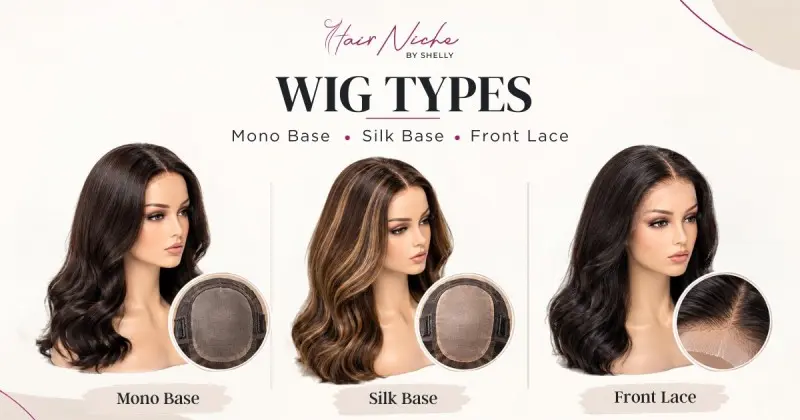
Wig types are defined by the base the hair is tied into. A silk base gives the most realistic parting, a mono base lets you move the parting freely and breathes well, and a front lace creates the most convincing hairline. Each solves a different part of looking natural.
Wig listings throw three or four construction terms at you as though the difference is obvious. It isn't — and they aren't competing versions of the same thing.
Each base solves a different problem. Once you know which problem matters most to you, the choice makes itself.
What wig base construction actually means
The base is the foundation the hair is attached to — the part that sits against your scalp. Everything you notice about a wig's realism comes from it.
Three jobs, and no single base does all three best — which is the whole reason several constructions exist rather than one winner:
- Making the parting look like scalp
- Making the hairline look like growth
- Staying comfortable and breathable all day
Silk wins the first. Lace wins the second. Mono is strongest on the third while staying flexible.
Silk base wig: the most realistic parting
A silk base hides the knots beneath a fine silk layer, so what shows at the parting is a smooth, scalp-like surface with hair appearing to emerge from it.
If your wig will be parted and seen from above — at a desk, across a table, in photographs taken standing over you — this is the base that holds up to that scrutiny. The Silk Base Full Head Wig is built for it.
The trade-off is that it sits very slightly thicker than lace, and the parting is generally fixed where it's made. Silk also rewards a careful colour match more than the other bases, because a convincing parting draws the eye straight to where the hair meets the base.
Mono base wig: flexible parting and breathability
A monofilament base is a sheer, durable mesh with each hair tied individually. Because the hairs aren't locked in one direction, you can shift the parting — centre today, side tomorrow.
It's also the most breathable of the three, which matters in Indian heat and for anyone with a sensitive scalp, including during medical treatment. The Mono Base Full Head Wig covers this.
The trade-off: the parting looks very good but not quite as scalp-perfect as silk under close inspection. For most daily wear that difference is academic — it shows up in photographs taken from above far more than in ordinary conversation.
Front lace wig: the most convincing hairline
A front lace panel replaces the wig's front edge with sheer mesh, hairs tied individually, so the hairline fades rather than starts.
Choose it when the front edge is what worries you — if you wear your hair off your face, pin it back, or find yourself checking your forehead in the mirror. The Front Lace Full Head Wig is the option here, and our guide to how a front lace hairline works covers placement and care in detail.
The trade-off: lace is the most delicate part of any wig and needs gentle handling.
Which wig type suits you
Many wigs combine approaches — a lace front with a mono or silk top is common — so you're often choosing an emphasis rather than one feature in isolation.
If you're torn, think about which part of a wig you'd notice first on someone else. Most people look at the hairline, then the parting. Whichever you'd clock first is the one worth paying for.
Start from how you'll wear it
The most reliable way to choose isn't comparing specifications. It's picturing an ordinary day.
If you part your hair in the middle and people see the top of your head, silk earns its place. If you push your hair back off your face constantly, lace matters more. If you're wearing it through long hot days, or your scalp is sensitive from treatment, mono's breathability will matter more than either.
Comfort and fit are a separate question from base type, and worth getting right too — sizing, strap adjustment and all-day wear are covered in our wig cap guide.
One base, one job
Silk for the parting, lace for the hairline, mono for freedom and breathability. Decide which of those three you'd notice first in the mirror, and you've chosen.
Still weighing them up? Book a free consultation and we'll match the base to how you'll actually wear it, or browse the full range of human hair wigs.
FAQs
1. What are the main types of wigs?
Wigs are usually classified by base construction: silk base, monofilament (mono) base and front lace. Silk gives the most realistic parting, mono allows flexible parting and breathability, and lace creates the most natural hairline.
2. What is a mono base wig?
It's a wig built on a sheer, durable mesh with each hair tied individually. Because the hairs aren't fixed in one direction, you can change your parting, and the mesh breathes well.
3. What is a silk base wig?
A silk base hides the knots under a fine silk layer, so the parting looks like scalp with hair growing from it. It's the most convincing option when your parting is on show.
4. Which wig type looks the most natural?
It depends which area you mean. Silk looks most natural at the parting, lace looks most natural at the hairline. Many wigs combine both.
5. Which wig base is best for a sensitive scalp?
A mono base, because the open mesh is the most breathable and sits lightly. It's a common choice during medical treatment when the scalp is more reactive.
6. Can I change the parting on any wig?
No. Mono bases are designed for a movable parting, while many silk and lace constructions have a fixed part line built in.
7. Which wig type is most durable?
Mono bases generally handle daily handling best. Fine lace is the most delicate component and needs the gentlest care.
8. Is a lace front necessary?
Only if the hairline is what concerns you. If you usually wear your hair forward or in a fringe, a lace front matters far less.
9. Can one wig have more than one base type?
Yes, and many do — a lace front combined with a mono or silk top is common, giving a natural hairline and a realistic parting together.
10. Does base type affect how a wig feels in hot weather?
Yes. Mono is the most breathable, lace is light at the front, and silk sits slightly thicker. In sustained heat, breathability is worth prioritising.