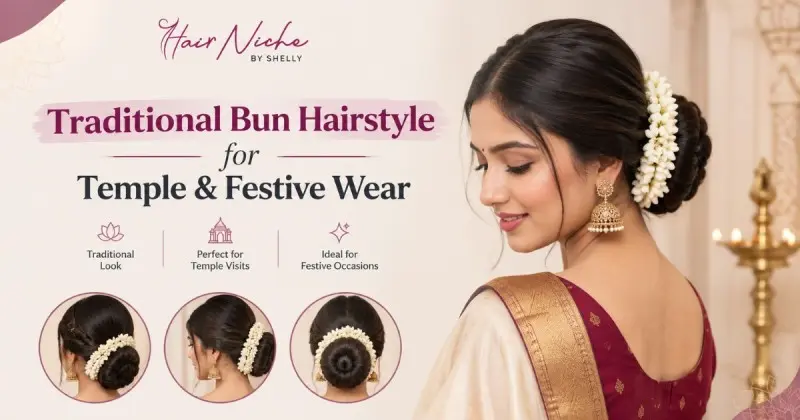
A traditional bun for temple or festive wear sits low at the nape, holds for hours, and is firm enough to carry a gajra. Smooth the hair with a little oil or serum, build the bun over a base for fullness, and pin it in a ring rather than one spot.
A bun worn to the temple has a harder job than a bun worn to dinner. It needs to stay neat through hours of standing, bending and walking, hold flowers without sagging, and look appropriate rather than styled.
These are the looks that have lasted generations, and the practical bits that make them hold.
Why the low bun became the traditional choice
It isn't only aesthetic. A bun at the nape is the most secure position on the head — the weight sits low, so it doesn't pull, and it stays put when you bend forward or cover your head with a dupatta or pallu.
It also suits the occasion. A low, neat bun reads as composed and modest, which is why it's been the default for temple visits and family functions across generations rather than anything fashion decided recently.
The classic temple hairstyle styles
The smooth low bun. Hair drawn back cleanly, coiled at the nape, secured. The most common and the most forgiving — it suits every face and every age, and there's no occasion it's wrong for.
The centre-parted bun. A clean centre parting with the hair drawn back into a low coil. The most traditional of all, and the natural base for a maang tikka or flowers along the parting.
The braided coil. Hair plaited first, then wound into a bun. The braid adds texture and holds its shape better than loose hair, which makes it a good choice for long events and for finer hair.
The side-swept bun. Gathered low and slightly to one side, which flatters a long face and photographs softly. Less formal, suited to festive rather than ritual occasions.
Festive bun with gajra: making flowers hold
A gajra is heavier than it looks, and it's the most common reason a bun sags by mid-afternoon.
The bun must be firm first. Flowers are pinned into a bun, so a soft, loose coil gives them nothing to hold onto. Build and secure the bun completely before any flowers go near it.
Pin the gajra in several places, not just where it meets. A strand secured at one point swings and drags the bun down with it.
Match the weight to the base. A heavy double gajra on a small, fine bun will pull. If you want a substantial gajra, build a substantial bun — which usually means adding to it.
Our fuller guide to a bun for saree with gajra and fresh flowers covers flower choices and placement in more detail.
When your own hair won't make the bun
This is the honest part. The traditional styles assume thick, long hair, and plenty of women don't have that — through age, thinning, or simply a shorter cut.
A clip-on bun gives you a full, traditional shape regardless of what your own hair can gather. The ClipNGO Bun comes in natural black and a natural brown shade, and it's firm enough to take pins and flowers — which is exactly what a gajra needs.
A donut or messy bun piece works too if you can gather a small ponytail, adding bulk to a bun your own hair starts. The full range is in our buns and scrunchies collection.
Making a bun that lasts all day
- Start with second-day hair, or add a little oil, serum or texture. Freshly washed hair is too slippery to hold.
- Smooth the surface with a fine comb and a touch of oil — the traditional sleek finish is also the most secure.
- Pin in a ring, not in one place. Four or five U-pins spaced around the bun hold far better than two pushed into the same spot.
- Pin against the direction of pull, pushing up into the bun rather than down into it.
- Secure the base before decorating. Everything else depends on this.
- Carry two spare pins. Everyone who has worn a bun to a long function knows why.
Dressing it for the occasion
Flowers along the parting or ringing the bun for temple visits and poojas. A simple gajra for everyday festive wear. Fresh jasmine for weddings and larger functions, where the scent matters as much as the look.
Keep decoration proportionate — a modest bun with a single gajra reads as traditional, while an overloaded one reads as costume.
Low, firm and well-pinned
That's the whole formula. A smooth low bun built over a firm base, pinned in a ring, decorated proportionately — it has lasted generations because it genuinely holds.
If your own hair can't make the bun the occasion calls for, book a free consultation and we'll match a piece to your length and shade.