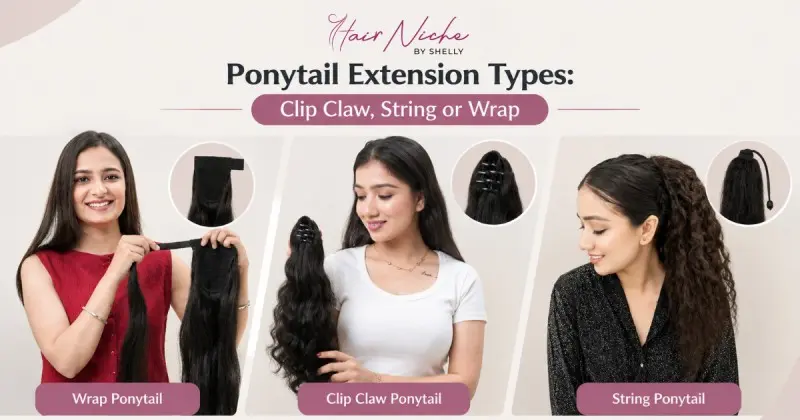
Ponytail extensions differ by how they attach. A claw clip grips your own ponytail, a wrap-around secures with a strand of hair wound over the base, a string or drawstring pulls tight around it, and a back clip attaches lower for length. Attachment decides security and speed.
All four give you a longer, fuller ponytail, so every comparison that focuses on the result ends up saying the same thing four times.
What actually differs is how each one holds on — and that decides whether it stays put on your hair, how fast it goes on, and how it copes with a long day.
Claw clip ponytail: fastest to wear
A claw clip ponytail has a hinged clip built into the base. You make a ponytail, clip the piece over it, and that's it — usually under a minute.
It's the quickest and easiest to remove, which makes it the realistic choice for everyday use. The clip grips your own gathered hair, so you need enough of a ponytail for it to close around.
The trade-off is weight. A long, heavy claw piece hangs from a single clip, so it can feel like it's pulling by evening and can loosen with a lot of movement. Better for a working day than for dancing.
Wrap around ponytail: the most seamless finish
A wrap-around secures by winding a strand of the extension's own hair around the base and pinning or fastening it.
That wrapped section hides the join completely, which is why this type gives the cleanest, most polished result — no visible clip, no elastic showing. If you're being photographed, it's the one that holds up.
It takes the longest to put on and a little practice to wrap neatly. For a sleek, formal ponytail it's worth the extra minutes.
String or drawstring ponytail: the most secure
A string ponytail has cords you pull tight around your own ponytail, usually with small combs that anchor into the base.
Pulling it tight distributes the hold rather than relying on one clip, which makes it the most secure of the four for a long day or heavy movement. It also handles weight better, so it suits longer and fuller pieces.
The trade-off is that tightening cords puts real tension on your own ponytail. If your hair is fine or your scalp is tender, don't pull harder than you need to — and don't wear it tight day after day in the same spot.
Back clip ponytail: adds length lower down
A back clip ponytail attaches lower, at the back of the head, rather than clipping onto a gathered ponytail at the crown.
That lower attachment reads naturally for a low ponytail and sits comfortably, with the weight spread across the back of the head rather than hanging from one point at the crown.
It's less suited to a high ponytail, where the join sits where people can see it.
Which ponytail extension type suits you
All four are stocked in natural black and brown shades in our ponytail extensions range.
Choosing by hair type, not just occasion
Fine or thin hair: a claw clip may not find enough to grip, and a tight drawstring puts tension on hair that can't spare it. A back clip spreads the weight more kindly.
Thick hair: you have the most freedom. A claw clip holds securely and a wrap-around has plenty of hair to conceal the join.
Short hair: all four need a base to attach to. If you can't gather a ponytail at all, a clip-on bun is usually the more realistic option — our guide to buns for short hair covers that.
Making any of them look natural
- Match the shade to your mid-lengths in daylight, not your roots.
- Hide the join with a wrapped strand of your own hair if the type doesn't conceal it.
- Match the texture. A poker-straight piece against wavy hair separates visibly at the join.
- Don't over-tighten. Security comes from correct attachment, not from pulling harder.
- Take it out at night, and vary where you position it between wears.
Pick by how it holds on
Claw for speed, wrap for a flawless finish, string for security through a long day, back clip for a comfortable low ponytail. Decide which of those four things matters most to you and the choice follows.
Not sure what your hair can carry? Book a free consultation and we'll match the type, length and shade.
FAQs
1. What are the different types of ponytail extensions?
The four main types are claw clip, wrap-around, string or drawstring, and back clip. They all create a fuller ponytail but differ in how they attach, which affects security and speed.
2. Which ponytail extension is most secure?
A string or drawstring ponytail, because the cords tighten around your own ponytail and distribute the hold rather than relying on a single clip. It also carries heavier pieces better.
3. What is a wrap-around ponytail?
It secures by winding a strand of the extension's own hair around the base. That wrapped section hides the join completely, giving the most seamless, polished finish of the four.
4. Which ponytail extension is quickest to put on?
A claw clip. You gather your own ponytail, clip the piece over it, and you're done, usually in under a minute. It's also the quickest to remove.
5. Are ponytail extensions suitable for fine hair?
Choose carefully. A claw clip may struggle to grip, and a tight drawstring adds tension fine hair can't spare. A back clip spreads the weight more kindly across the back of the head.
6. Do ponytail extensions damage your hair?
Not when worn sensibly. The risk is tension — over-tightening a drawstring or wearing a heavy piece in the same spot daily. Vary the position and remove it at night.
7. How do I hide where the extension joins my hair?
Wrap a small strand of your own hair around the base and pin it. Wrap-around and back clip types conceal the join more naturally than a claw clip does.
8. Which type is best for a high ponytail?
A claw clip or wrap-around, since both attach at the gathered ponytail. A back clip sits lower, so the join can show in a high style.
9. Can I wear a ponytail extension all day?
Yes, though comfort varies by type. A drawstring holds most securely for long days, while a heavy claw clip can start to pull by evening.
10. Does the extension need to match my hair texture?
Yes. Colour gets the attention, but a straight piece against wavy hair separates visibly at the join. Match texture as carefully as shade.