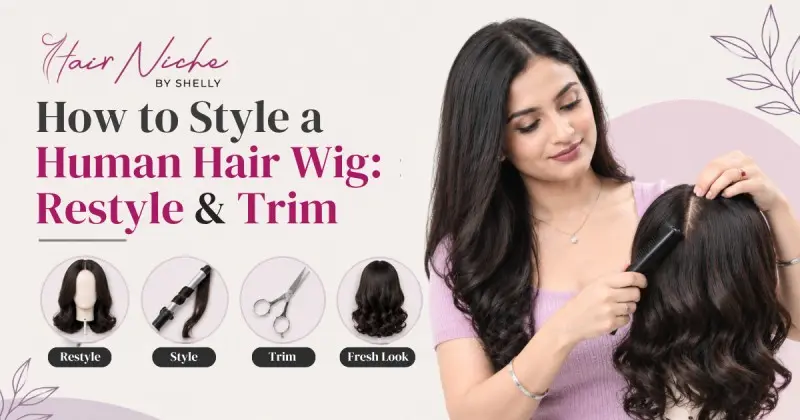
A human hair wig can be curled, straightened, parted and trimmed exactly like your own hair, with one difference that governs everything: it doesn't repair itself and it doesn't grow back. Use lower heat, style less often, and have significant cuts done professionally.
This is the real advantage of human hair over synthetic — you aren't stuck with the style it arrived in. You can wave it, smooth it, move the parting, and cut it to suit your face.
The catch is that every change is permanent in a way it never is on your own head. A bad decision doesn't grow out.
The rule behind every styling instruction
Your hair has a scalp supplying oil and a follicle producing new growth. Damage gets replaced and eventually trimmed away.
A wig has neither. Heat damage stays. An over-enthusiastic trim stays. Colour that's gone wrong stays.
Everything below follows from that, and it's why the sensible approach is to style less than you would your own hair, not more.
Heat styling a wig without ruining it
Human hair wigs take heat well, within limits:
- Keep temperatures moderate. Lower than you'd use on your own hair, and well below the maximum on the tool. There's no benefit to high heat and all the damage is cumulative.
- Always use heat protection, every time, without exceptions.
- Style dry. Heat on damp wig hair causes far more damage than on your own.
- Work in sections so each piece needs one pass rather than several.
- Avoid the base. Keep irons and wands away from the lace, silk or mono top — heat damages the base material, and the base is what makes the wig look real.
That last point gets missed constantly. People protect the hair and melt the thing holding it.
Restyle a wig: parting, waves and volume
Changing the parting depends on construction. A mono base is designed for it; many silk and lace tops have a fixed part. Forcing a new parting on a fixed-part wig stresses the knots and rarely sits convincingly — check what yours allows before trying.
Adding waves is the most common restyle and the most forgiving. A wand on moderate heat, curls brushed out softly, gives a completely different look from the same piece.
Adding volume is best done with technique rather than teasing. Backcombing a wig damages knots and loosens hair that can't be replaced. Lifting sections while they cool after styling creates volume without the damage.
Updos and ponytails depend on the cap. A wig without a secure fit will shift when you pull hair back, and a visible nape edge is more exposed in an updo than you'd expect.
Trim a wig to suit your face
This is where a wig stops looking like a wig and starts looking like your hair — and it's the step most people skip.
Wigs arrive in standard lengths and shapes. Face-framing layers, a softened blunt edge, or simply taking length off so it suits your height make an enormous difference to how natural it reads.
Have it done professionally if you can. A stylist who cuts wigs understands that the hair doesn't grow back, and will cut conservatively. Many salons will do this even if you didn't buy the wig there.
If you're trimming at home:
- Cut it dry, on a wig stand, not on your head — wig hair doesn't shrink and spring the way wet growing hair does, so wet cutting misleads you.
- Take far less than you think, then reassess. You can always cut more.
- Use sharp hair shears, never kitchen scissors, which crush the ends.
- Point-cut into the ends rather than cutting straight across, for a softer, less wiggy edge.
- Never cut the lace or base. Trimming excess lace at the hairline is a separate, careful job — not part of a style trim.
A shorter wig such as the Bob Cut Full Head Wig usually needs the least customisation, while a longer piece like the Seamless Front Hairline Wig has more scope to be shaped to your face.
What to avoid
- Daily heat styling. The single fastest way to age a wig.
- Backcombing the base area.
- Bleaching or lightening — the risky direction on any hairpiece.
- Sleeping in a styled wig, which undoes the style and mats the hair.
- Heavy oils and serums, which build up and can't be flushed out by a scalp.
Our post on common wig mistakes covers the fit and preparation errors that spoil an otherwise good style.
Style it like your hair, but spend it carefully
Treat heat and scissors as a budget that doesn't refill. Used sparingly, a human hair wig can be several different looks over its life — and a good trim is the single best thing you can do to make one look like it was always yours.
For help choosing a length that needs the least customisation, book a free consultation, or browse the human hair wigs range.
FAQs
1. Can you style a human hair wig like your own hair?
Yes — it can be curled, straightened, parted and trimmed. The difference is that it doesn't repair itself or grow back, so use lower heat and style less often than you would your own hair.
2. What temperature should I use on a human hair wig?
Moderate, and lower than you'd use on your own hair. Always apply heat protection, style on dry hair, and work in sections so each piece needs only one pass.
3. Can I trim a wig myself?
You can, carefully: cut it dry on a stand, take far less than you think, use sharp shears and point-cut the ends. For a significant restyle, a stylist experienced with wigs is worth it.
4. Should I cut a wig wet or dry?
Dry, and on a stand. Wig hair doesn't shrink and spring back like wet growing hair, so cutting wet makes it easy to take off far more than intended.
5. Can I change the parting on my wig?
It depends on the base. Monofilament tops are designed for a movable parting, while many silk and lace tops have a fixed part that doesn't move convincingly.
6. Can I backcomb a wig for volume?
It's best avoided — backcombing damages the knots and loosens hair that can't be replaced. Lifting sections while they cool after heat styling builds volume more safely.
7. Will heat styling shorten my wig's life?
Yes, cumulatively. There's no repair mechanism, so every styling session adds up. Moderate heat, protection and styling only when needed keep a wig looking new far longer.
8. Can I put a human hair wig in a ponytail?
Often yes, depending on the cap and construction. A secure fit matters, since pulling hair back puts tension on the wig and exposes the nape edge.
9. Should I cut the lace on my wig myself?
Trimming excess lace is a careful, separate job from a style trim, and it's easy to cut too far. If you're unsure, have it done professionally the first time.
10. Can a wig be restyled more than once?
Yes, though each restyle uses some of the hair's finite tolerance for heat. Changing the look occasionally is fine; changing it daily shortens the wig's life considerably.