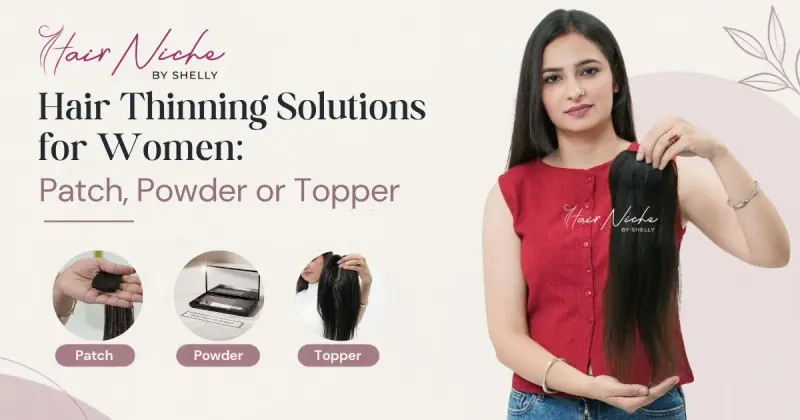
Choose by how much scalp is showing. Powder reduces the contrast in a small gap, a patch covers one defined spot, and a topper covers the parting and crown. If your hair still hides your scalp entirely, you need volume rather than coverage — a different solution again.
Most women researching this have already been down a confusing path of shampoos, serums and conflicting advice, and arrive wanting one straight answer: what actually covers this?
The answer depends on one thing you can check in a mirror tonight.
Start here: how much scalp is actually showing
Part your hair as you normally do, under a bright light, and look honestly.
- No scalp visible, but hair looks flat and fine → you need volume, not coverage.
- A small gap or a pale line at the parting → powder is enough for now.
- One defined area where skin shows → a patch.
- The parting and crown are visibly thin → a topper.
- Thinning across your whole head, including sides and back → a wig.
That sequence is the entire decision. Everything below is detail.
Scalp concealer powder: the smallest fix
A tinted powder pressed along the parting reduces the contrast between dark hair and pale scalp, so a small gap stops catching the eye. It's instant, cheap and washes out.
Its limits are real, though. It won't cover a broad thinning area — spread wide it looks flat in daylight — and it doesn't survive rain or swimming. Treat it as an event fix, not a daily routine.
It's also worth knowing that powder works by reducing contrast rather than adding anything. On very pale scalp with dark hair it makes a striking difference; where the contrast is already low, you may barely notice it.
Hair patch vs topper: the real decision for most women
This is where most women actually land, and the difference is simply size and location.
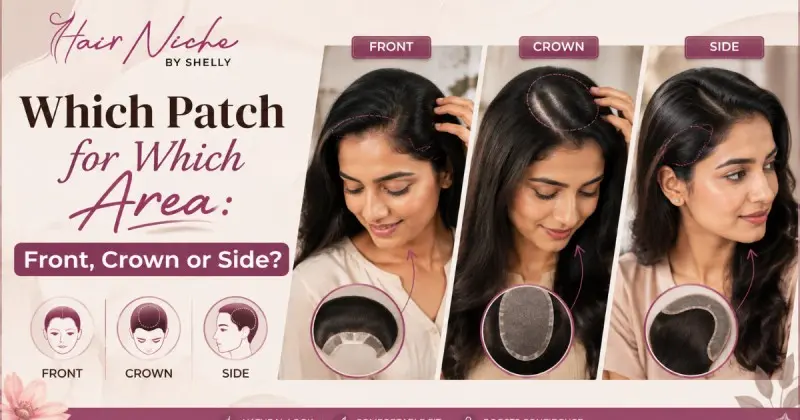
A patch covers one defined area — a spot at the crown, a sparse patch, a thin section along the part. It's light, discreet and the least fuss, because it covers only what needs covering. The Invisible Cover up Patch suits a localised spot.
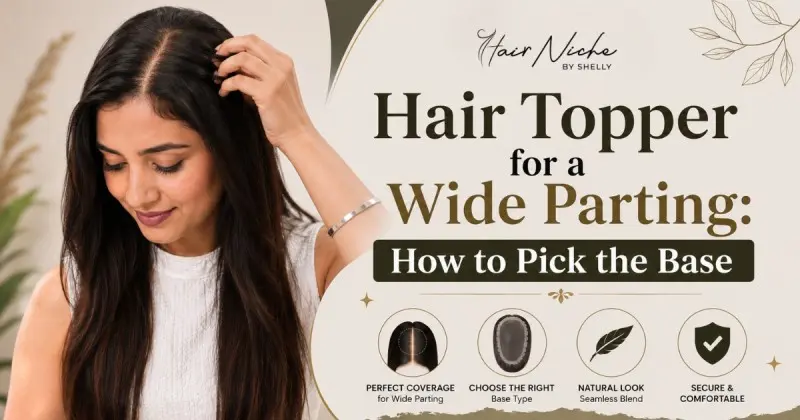
A topper covers the whole top — parting and crown together — with a base that recreates a natural-looking scalp. Choose it when the thinning isn't one spot but a general area. For a widening parting specifically, the Scalp Line Topper covers that line without the bulk of a full topper.
The simplest test: if you can point to the problem with one finger, a patch will do. If you'd have to draw a circle, you want a topper.
Sizing follows the same logic. Whichever you choose, it should be slightly larger than the visible thinning so the edges rest on hair rather than skin — undersizing is the single most common reason a piece looks obvious.
When you need volume instead
This is the most common mis-purchase in the whole category, so it's worth being blunt.
If your scalp isn't actually visible and your hair has simply lost density, no amount of coverage will help — you'll have bought a piece designed to hide skin that isn't showing. What you need is body, and a clip-in volumizer such as the One Set Volumizer (4 Clips) adds it in minutes.
Volumizers add hair around your hair. Patches and toppers cover skin. They aren't interchangeable.
How to cover thinning hair: the full picture
Most women move down this list over time rather than jumping to the end, and there's no need to buy ahead of where you are.
And get the cause looked at
None of these treats anything — they cover. Thinning in women has causes that are often treatable, including thyroid problems and iron deficiency, both identified with simple blood tests.
Covering and investigating aren't alternatives. Wear the coverage while you find out.
Match the solution to what you see
Powder for a gap, a patch for a spot, a topper for the top, a volumizer when nothing's showing but everything's flat. Look properly first and you'll buy once.
If you'd rather have someone look with you, book a free consultation — we'll tell you honestly which of these you need, including if the answer is "none of them yet". Or browse the full thin hair solutions range.
This article is for information only and isn't medical advice; speak to a doctor about diagnosis and treatment.
FAQs
1. What's the best solution for thinning hair in women?
It depends on how much scalp is showing. Powder suits a small gap, a patch covers one defined spot, a topper covers the parting and crown, and a volumizer adds density when no scalp is visible.
2. What's the difference between a hair patch and a topper?
Size and area. A patch covers one localised spot, while a topper covers the whole top of the head including the parting and crown. If you can point to the problem with one finger, a patch is enough.
3. Does scalp concealer powder actually work?
For small gaps, yes — it reduces the contrast between hair and scalp so the thinning is far less noticeable. It won't cover a broad area and it washes out, so it's best for events.
4. Will a volumizer cover my scalp?
No. Volumizers add fullness around existing hair but can't hide skin. If scalp is visible at your parting, you need a patch or topper instead.
5.How do I know if I need a wig instead?
When thinning has spread across your whole head, including the sides and back, there isn't enough hair left for a topper to blend into. That's the point a wig makes more sense.
6.Can I use powder and a topper together?
Yes. A little powder where the piece's edge meets your own hair can soften the transition if your parting is very pale, though a well-matched topper usually doesn't need it.
7.Which option is the least noticeable?
A correctly sized patch is the most discreet for a single spot. For broader thinning, a well-matched topper on a silk base is the most natural-looking option.
8.Do any of these damage my remaining hair?
Not when worn sensibly. Clip into fuller hair away from fragile areas, vary the clip positions, and take pieces off at night.
9.Should I buy the largest option to be safe?
No. Buying ahead of where you are means covering hair that doesn't need covering, which adds weight and is more visible, not less. Match the piece to what's actually showing.
10.Do I still need to see a doctor?
Yes. Coverage conceals the appearance but doesn't treat the cause, and several common causes such as thyroid problems and iron deficiency are treatable once identified.