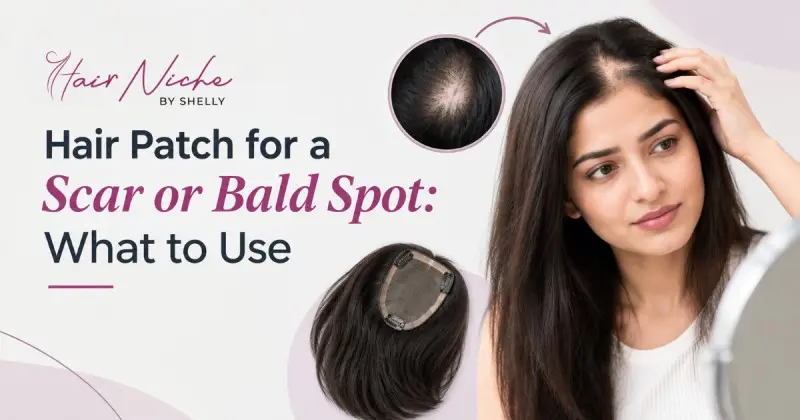
A hair patch covers a scar or bald spot by clipping into the healthy hair surrounding it, since scar tissue and bare patches have no hair of their own to attach to. Choose a patch slightly larger than the area so the edges rest on hair, and attach away from fragile skin.
A scar from an old injury or surgery, or a bald spot from alopecia, is a different problem from thinning hair — and most advice doesn't acknowledge that.
Thinning still has hair in it. A scar doesn't. That single difference changes how you size a patch, where you clip it, and what you need to be careful of.
Why a scar or bald spot needs different thinking
With thinning, a piece sits over hair that's still there and simply adds density. The attachment points are right where you need coverage.
With a scar or a bare patch, there's nothing in the middle to hold onto. All the attachment has to happen at the edges, in the healthy hair around the area — which means the patch must be large enough to reach that hair comfortably, and placed so no clip ever sits on the scar itself.
That's the whole principle. Everything below follows from it.
Scar cover hair piece: sizing it properly
Measure the bare area at its widest and longest, then add a margin on every side — more than you'd add for thinning. You need enough overlap that the clips land securely in hair, not at the very edge of the scar where hair is often sparse or fragile.
Undersizing is the common mistake. A patch that only just covers the spot has nowhere safe to anchor, so it shifts, and the edges lift to reveal exactly what you were covering.
For a small, defined spot, the Invisible Cover up Patch covers a localised area discreetly. For something broader, the Broad Cover up Patch or the Extra Wide Cover Up Patch give more surface and more room to anchor.
Attaching it safely over scar tissue
Scar tissue is more fragile than normal scalp. It can be thinner, less elastic, and sometimes more sensitive — and it doesn't regrow hair, so anything you damage around it matters more.
- Never clip onto the scar. Clips belong in healthy hair outside the area, always.
- Spread the hold. Anchoring at several points around the edge is kinder than gripping hard at one.
- Vary the clip positions between wears, so the border hair isn't under constant tension.
- Check for irritation. If the skin around a scar becomes sore or reddened, stop and let it rest.
- If the scar is new or still healing, wait. Ask your doctor before covering recent surgical sites.
Cover a bald spot from alopecia
A bald patch from alopecia areata is smooth rather than scarred, and in many people hair regrows — sometimes on its own, sometimes after treatment, though it can also come and go.
Practically that means two things. The hair around the patch is usually healthy, which gives you good anchoring. And the patch may change size, so a slightly generous piece is more useful than one fitted exactly to today's measurement.
DermNet's overview of alopecia areata explains the condition and when to seek treatment. Covering it doesn't interfere with anything a dermatologist recommends.
Patch for alopecia spot vs scar: what differs
Matching it so it disappears
Three things, as with any piece: match the colour to your mid-lengths in daylight, keep the density close to the hair around the patch rather than fuller, and let a little of your own hair fall across the edges so there's no visible border.
A patch covering a bare area can look denser than its surroundings if you size the density up — which draws the eye to the exact spot you're concealing. Matching, not maximising, is the rule.
Our general guide to hair patches for thinning hair covers types and care in more depth.
Cover the spot, protect the edges
A scar or bald spot needs a patch large enough to anchor in healthy hair, attached well clear of the fragile area, and matched rather than over-dense. Get those three right and it simply isn't visible.
If you'd like help sizing something for a specific scar or patch, book a free consultation — we'll look at the area and the hair around it with you. Or browse the full range of cover-up patches.
This article is for information only and isn't medical advice; speak to a doctor about diagnosis and treatment, and before covering any recent or healing wound.
FAQs
1. Can a hair patch cover a scar?
Yes. A patch clips into the healthy hair around the scar and covers the area in between. It needs to be large enough that the clips anchor in hair rather than at the scar's edge.
2. What size patch do I need for a bald spot?
Measure the bare area and add a generous margin on every side, so the edges and clips rest comfortably in surrounding hair. Undersizing is the most common mistake.
3. Can I clip a patch directly onto a scar?
No. Clips should only attach to healthy hair outside the area. Scar tissue is more fragile, and there's no hair there to grip in any case.
4. Will a hair patch damage the skin around a scar?
Not when attached sensibly. Spread the hold across several points, vary the clip positions between wears, and stop if the surrounding skin becomes sore.
5. Can I cover a recent surgical scar?
Ask your doctor first. A healing wound shouldn't be covered with a hairpiece until it's fully healed and you've been told it's safe.
6. Is a patch suitable for an alopecia areata spot?
Yes, and the surrounding hair is usually healthy, which gives good anchoring. Choose a slightly generous size, since these patches can change in size over time.
7. Will the patch look denser than the rest of my hair?
It can if you choose a density higher than your own hair, which draws attention to the area. Match the surrounding density rather than maximising it.
8. How do I stop the edges of the patch showing?
Size it generously so the edges rest on hair, match the colour to your mid-lengths in daylight, and let a little of your own hair fall across the border.
9. Can hair grow back in a scar?
Scar tissue generally doesn't regrow hair, which is why coverage is the practical option. A bald patch from alopecia is different and often does regrow.
10. Is a patch or a topper better for a bald spot?
A patch suits a single localised spot. If the area is large or there are several spots across the top of your head, a topper covering the whole area is usually more comfortable.