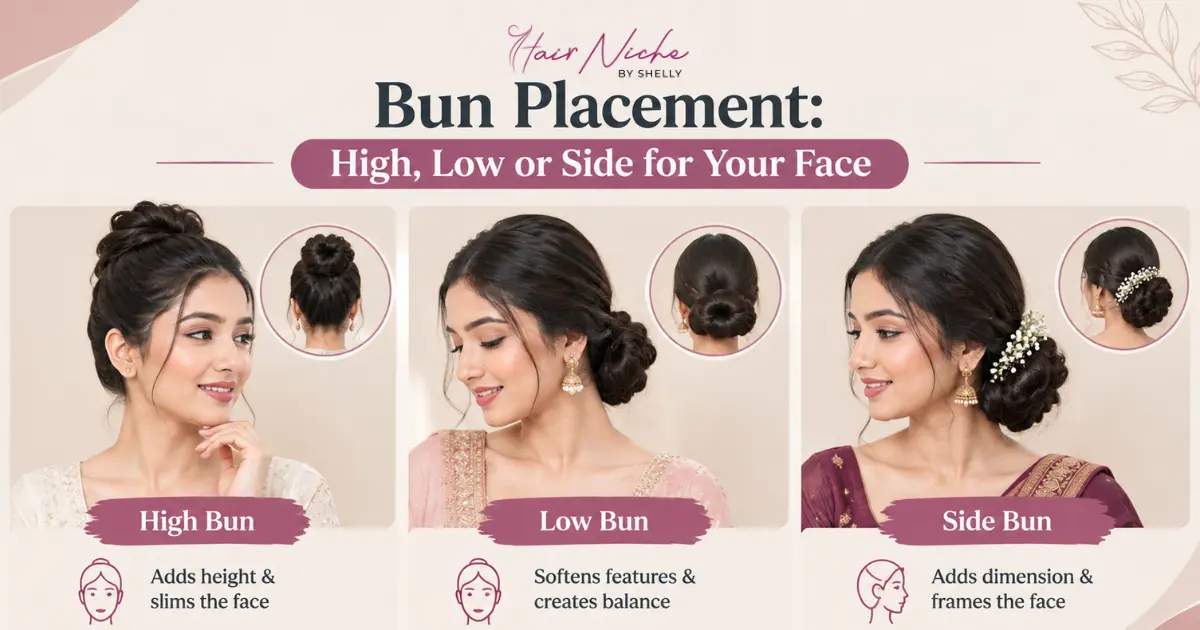
Where you place a bun changes your face shape more than the bun itself does. A high bun adds height and lengthens the face, a low bun widens and softens it, and a side bun breaks symmetry to flatter angular or long faces. Match the placement to the proportion you want to balance.
Two women can wear the identical bun and look completely different, and it has nothing to do with the bun.
Placement is doing the work. Move it two inches up or down and you change the apparent length of someone's face — which is a bigger effect than most haircuts manage.
The one principle behind all of it
Height lengthens. Low widens.
A bun sitting high on the crown adds vertical lines, so the face reads longer and narrower. A bun at the nape removes that height, so the face reads shorter and wider.
Everything below is that one rule applied to different faces.
It's worth testing on yourself before reading further. Gather your hair at the crown and look, then hold the same hair at your nape and look again. The difference is usually obvious once you've seen it side by side.
High bun face shape: who it suits
A high bun lifts everything — the eye travels up, the neck looks longer, the face reads more elongated.
It flatters round faces, which gain the length they lack, and heart or square faces, which get a lifted, balanced look. It also suits anyone wanting a sharper, more striking silhouette.
Be careful if your face is already long or oblong. Adding height to a long face makes it longer, which is the most common placement mistake there is. Our guide to hairstyles for oblong and long faces explains the wider principle.
Also consider a high bun pulls the hairline tight, so it's less forgiving if your temples or hairline have thinned. It's also the least comfortable placement for a long day, since the weight sits high and pulls at the crown.
Low bun: the most universally flattering
A low bun at the nape adds no height, so the face keeps its natural proportions and the overall effect is softer.
It flatters long and oblong faces especially, which benefit from losing height, and it's the safest choice for almost every face shape. It's also the most secure placement and the most appropriate for formal and traditional settings.
Be careful if your face is very round — a low bun with hair pulled flat can widen it further. Leaving some softness or volume at the crown prevents that.
For fuller shape at the nape when your own hair won't produce it, a clip-on piece like the ClipNGO Bun builds the bun regardless of length.
Side bun: breaking the symmetry
A side bun sits low and off-centre, which introduces a diagonal line and breaks the face's symmetry.
It flatters angular faces — square or sharply defined jaws — because asymmetry softens hard lines. It also suits long faces, since the sideways pull counteracts vertical length, and it photographs beautifully in profile.
Be careful with very round faces, where off-centre weight can emphasise roundness rather than balance it.
It's the least formal of the three, so it reads better at receptions and functions than in strictly traditional settings.
Placement by face shape
If you're not sure of your shape, the practical shortcut is proportion: if your face is longer than it is wide, go low. If it's wider than it is long, go high.
Three things that matter as much as placement
What you leave out. A few soft pieces at the front soften any placement. A completely scraped-back bun is the least forgiving version of every style on this list.
Crown volume. A little lift at the crown stops a low bun looking flat and stops a high bun looking severe. It's the difference between "done" and "pulled back".
Size in proportion. A large bun on a small frame overwhelms it; a tiny bun on a tall frame looks like an afterthought. Match the bun to your head and height, not to the photo you saved.
The pieces for building any of these are in our buns and scrunchies collection, and our comparison of bun extension types covers which attaches best.
Move it before you rule it out
If buns have never suited you, the odds are the placement was wrong rather than the style. Try the same bun two inches lower, or shifted to one side, and look again — it's a thirty-second experiment that changes the whole face.
For help choosing a piece that suits your placement and length, book a free consultation.
FAQs
1. Does bun placement really change how your face looks?
Yes, considerably. A high bun adds height and lengthens the face, while a low bun removes height and widens it. The effect is often greater than changing the style of bun.
2. Which bun placement suits a round face?
A high bun, because the added height gives a round face the length it lacks. Avoid a completely flat low bun, which can widen the face further.
3. What bun suits a long or oblong face?
A low bun or a side bun. Both avoid adding height to a face that's already long, and a side bun's diagonal line counteracts vertical length.
4. Is a low bun flattering on everyone?
It's the most universally flattering placement and the safest default. Very round faces should keep a little volume at the crown so it doesn't widen the face.
5. Which placement suits a square face?
A side bun, since asymmetry softens a strong jaw. A soft low bun also works, while a severe high bun can emphasise angular lines.
6. When should I wear a side bun?
For receptions, functions and occasions where a softer, less formal look suits. It's especially flattering on angular and long faces, and photographs well in profile.
7. Does a high bun suit thinning hair?
It's less forgiving, because pulling hair up tightly exposes the hairline and temples. A low bun with softness at the front is usually kinder.
8. How do I know my face shape?
Compare length to width. If your face is longer than it is wide, treat it as long and go low. If it's wider than it is long, treat it as round and go high.
9. Should I leave pieces out around my face?
Almost always. A few soft front pieces flatter every placement, while a completely scraped-back bun is the least forgiving version of any bun style.
10. How big should my bun be?
In proportion to your head and height. An oversized bun overwhelms a small frame, and a very small one can look like an afterthought on a tall one.