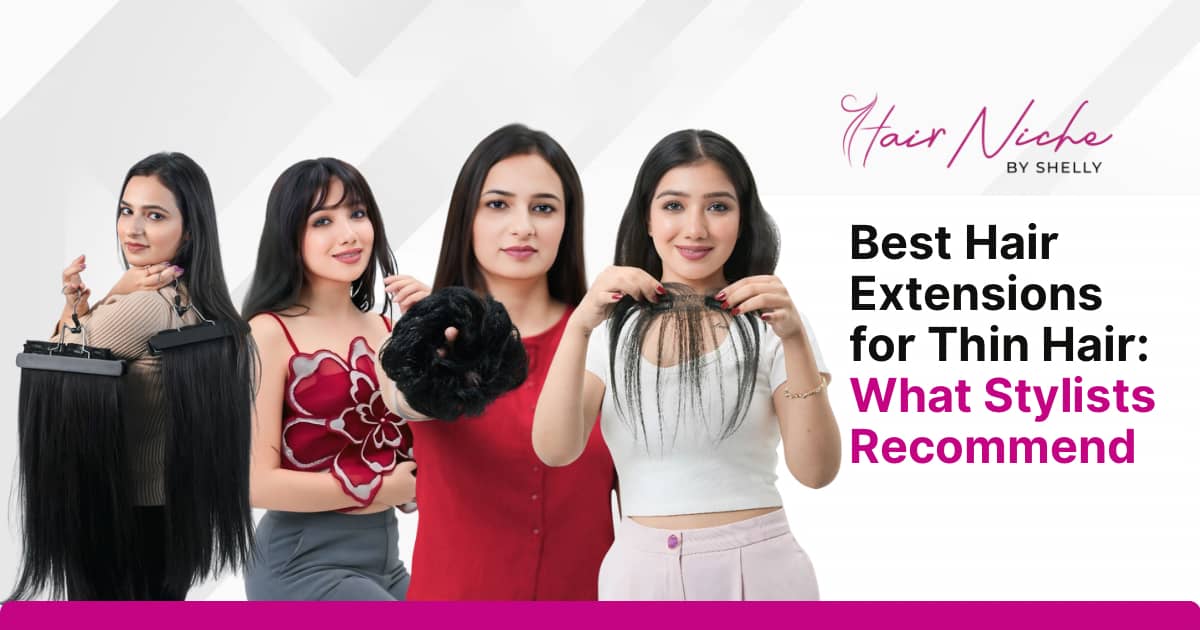
If you've gone looking for the best hair extensions for thin hair, you've probably hit the same wall everyone else does: most advice is generic and ignores what fine hair actually needs. Thin hair can't carry heavy wefts, can't tolerate high-tension attachment, and shows every flaw if the blend isn't right.
The good news — there are extensions built specifically for this. Lightweight, low-tension, and designed to add fullness without stressing your roots. Here's what stylists actually recommend, and why.
Why Thin Hair Needs a Different Approach
Thin hair is about strand density, not texture — you can have straight, wavy, or curly hair that's still fine in density. The most common frustrations:
- Flat roots with no lift
- Visible scalp through the part
- Breakage under heavier styles
- Slow, fragile regrowth
This is exactly why "just any" extension doesn't work. You need something engineered for low weight and low tension.
5 Things to Check Before You Buy
The Best Hair Extensions for Thin Hair, Compared
1. Clip-In Extensions — The Most-Searched Option
Clip-ins are the easiest entry point: no salon visit, no commitment, fully removable. But not all clip-ins suit thin hair. The trick is choosing sets with smaller, finer wefts rather than one bulky piece — this spreads weight evenly and sits flatter against the scalp.
Stylist tip: Tease your roots slightly and anchor with bobby pins before clipping in for a more secure, flatter base.
2. Tape-In Extensions — The Everyday Favorite
Flat, lightweight wefts sandwich a thin slice of your natural hair, lying flush against the scalp. They're virtually undetectable in fine hair and don't pull at the root.
Stylist tip: Ask for single-sided tape if your hair is extremely fine — it reduces bulk even further.
3. Halo Extensions — Zero Damage, Instant Results
A single weft attaches to an invisible wire that rests around the crown. Weight is distributed across the whole head instead of concentrated at the roots, making this one of the gentlest options available.
Stylist tip: Curl your natural hair around the wire to hide it completely.
4. Hand-Tied Wefts — Salon-Level Fullness
Ultra-thin wefts are sewn into small beads across the head — no heat, no glue. They lie flatter than machine wefts, which is exactly what fine hair needs.
Stylist tip: Sleep in a loose braid to avoid tangling around the beads.
5. Micro/Nano Tape — For Ultra-Fine or Thinning Crowns
A more delicate evolution of standard tape-ins, using barely-visible micro wefts. Great for postpartum thinning or early-stage hair loss.
Stylist tip: Best applied by a stylist experienced specifically in micro-tape work — not all salons offer it.
6. Hair Toppers — For Visible Thinning or Alopecia
Small, wig-like pieces that sit on the crown and blend with natural hair, offering real coverage rather than just added volume.
Stylist tip: A lace or silk base gives the most natural-looking scalp.
What to Avoid With Thin or Fragile Hair
Skip these unless your hair is unusually strong:
- Heavy clip-ins with large, single wefts
- Glue-in extensions (high breakage risk)
- Fusion extensions using heat and keratin glue
- Weaves or sew-ins that rely on braided foundations
Daily Care: 5 Habits That Make Extensions Last
- Brush gently — use a loop brush, starting at the ends and working up
- Wash less often — 2–3 times a week with sulfate-free shampoo
- Keep heat off the bonds — always use heat protectant, avoid direct heat near tapes
- Sleep smart — loose braid, silk pillowcase, less friction
- Moisturize the ends only — light leave-in conditioner, never near the roots
Human Hair vs. Synthetic: Which Actually Blends Better?
For thin hair specifically, this isn't a close call. 100% Remy human hair holds heat styling, moves naturally, and blends seamlessly with fine strands. Synthetic hair is cheaper upfront but tends to look shiny, doesn't take heat styling, and is harder to disguise against thin natural hair.
A Quick Decision Guide
- Want zero commitment? → Halo or lightweight clip-ins
- Want an everyday, invisible look? → Tape-ins or micro tape
- Want longer-term fullness with no heat? → Hand-tied wefts
- Dealing with visible thinning or bald spots? → Hair toppers
Final Thoughts
The best hair extensions for thin hair all share three traits: they're lightweight, low-tension, and applied (or chosen) with your hair's specific fragility in mind. Get a professional consultation if you're unsure which method suits your density, and pair whichever extension you choose with a gentle care routine — that combination is what actually makes the difference long-term.
Explore tape-ins, halos, clip-ins, and hair toppers built specifically for thin hair at Hair Niche — India's hair extension boutique curated by professionals.
FAQs
Q1. What are the best hair extensions for thin hair?
Lightweight, low-tension options like tape-ins, halos, and fine clip-in sets — they distribute weight evenly instead of pulling at the roots, helping prevent breakage.
Q2. What are the best clip-in hair extensions for thin hair?
Sets with smaller, finer wefts rather than one bulky piece — they sit flatter, blend better, and put less strain on fragile roots.
Q3. What types of hair extensions work best for thin hair?
Halo, hand-tied wefts, and tape-ins, since they're lightweight and spread tension evenly rather than concentrating it at the root.
Q4. Are permanent hair extensions safe for thin hair?
Yes, when applied professionally using gentle bonding or micro-link methods — avoid heavy fusion or glue-based methods.
Q5. How do I choose the right extensions for my thin hair?
Match texture and color, prioritize lightweight wefts, and pick a method you can realistically maintain without extra tension or heat.
Q6. How long do extensions last on thin hair?
With proper care, 3–6 months overall; tape-ins and clip-ins specifically need reinstallation or removal every 6–8 weeks.
Q7. Can extensions damage thin hair?
Not if you choose lightweight options and follow gentle care — most damage comes from heavy wefts, glue, or fusion methods.
Q8. How can I care for thin hair extensions?
Sulfate-free shampoo, gentle detangling from the ends up, no tight hairstyles, and no heavy oils near the roots or bonds.
Q9. Can extensions add volume to thin or fine hair?
Yes — they add instant body and fullness, making fine hair look noticeably thicker without any surgical or topical treatment.
Q10. How do Hair Niche extensions help thin hair look fuller?
They're built ultra-lightweight, adding natural volume and density without weighing down or straining fine hair.